
Accessible to every player from day one.
- Keyboard and screen reader play, with every view described in words
- Nothing depends on color alone
- Timer counts up, so no one runs out of time
A daily puzzle about seeing one problem from every side.
Players see a block structure only through drawings from the top and two sides, then build one structure that satisfies every view with as few blocks as possible. I designed and directed it in one working session, built with Claude by Anthropic.
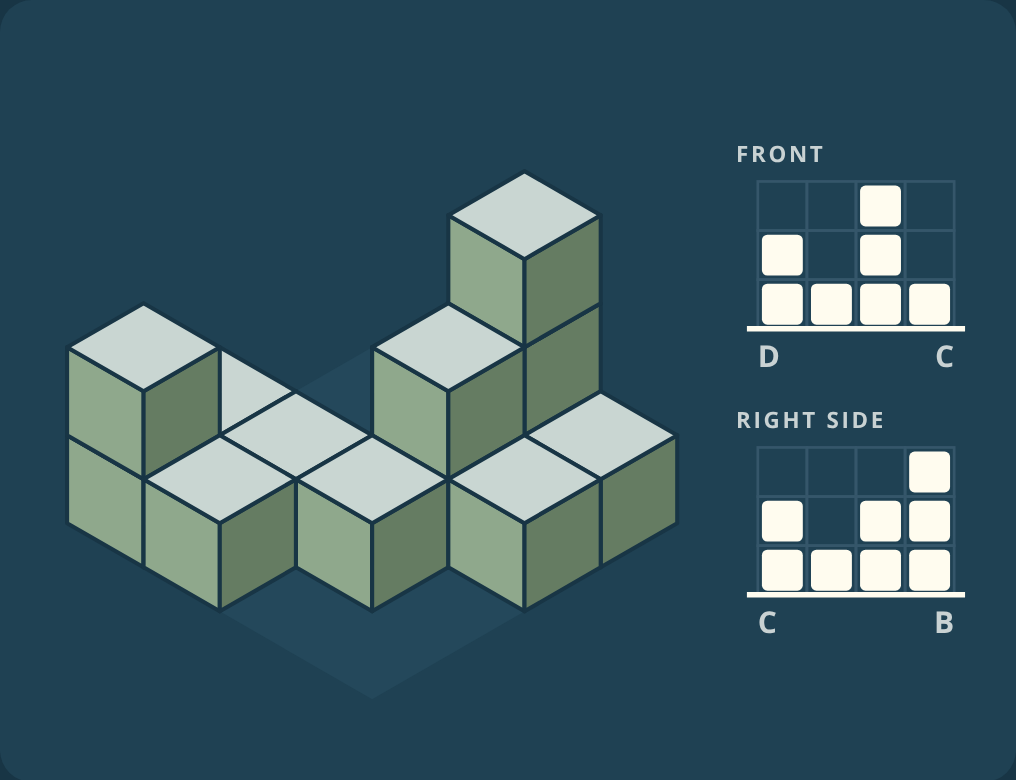
One structure, and how it looks from the front and from the right. Players work backward from views like these.
I play LinkedIn's daily puzzles, and Zip and Wend are my favorites. I wanted one that exercises the skill I use most at work: predicting, analyzing, and looking at a problem from several perspectives.
The most important call was walking away from a working prototype.
Step 5 is the turning point.
Every viewpoint sees part of the truth. Good decisions reconcile them.
The idea behind Viewpoints
I set the goals, made the judgment calls, and decided what shipped. Claude built what I directed.
Product owner, learning experience designer, quality reviewer
Developer, illustrator, tester
Every call I made on October 26, 2026, and the reason behind it. Newest first.
| # | Decision | Why |
|---|---|---|
| 14 | Separate practice levels from the daily puzzle, and show locks plainly | Faded locked levels and an unexplained “new puzzle tomorrow” confused me as a first-time player |
| 13 | Add an accessibility statement with a way to report barriers | A professional signal that accessibility is a commitment |
| 12 | Credit both creators and link to my portfolio | Honest attribution of AI help, and a path to my work |
| 11 | Free to play, shared on LinkedIn and with family and friends | The goal is engagement and feedback, not sales |
| 10 | Verify WCAG 2.2 AA, Section 508, mobile, and cross-browser support | Compliance has to be checked, not assumed |
| 9 | Build Viewpoints first | An original mechanic with a clear leadership message |
| 8 | Rank the new concepts: Viewpoints, Fold, Seating Chart | Viewpoints best matched how I like to solve problems |
| 7 | Retire Face Shift and create original games | It was still too close to the toy that inspired it |
| 6 | Explore names: Quadface, 2x2 Match, Shift Faced, Mix-n-Match | Tested names for clarity, searchability, and professional tone |
| 5 | Make shape matter from the first level, color second | Easy levels let players match by color alone, which taught the wrong skill |
| 4 | Colorblind-safe palette with a unique pattern per color | Color can never be the only cue (WCAG 1.4.1) |
| 3 | Replace the faces with original geometric art | The first version looked too much like the commercial toy |
| 2 | Adults, tap-to-flip controls, three modes, shareable link | Scoped before building, the way I scope a learning project |
| 1 | Ask questions before creating anything | Avoid building the wrong thing |
Concept choice, audience, rules, accessibility requirements, playtesting, and final approval.
Code, artwork, and the puzzle generator, produced by Claude at my direction.
Disclosing AI use builds trust. Directing AI well is a skill in its own right. How I use AI